


As long as people and vehicles are in close proximity, traffic safety is of great concern. Aggressive driving poses a safety risk to pedestrians near playgrounds and schools, in parking lots and in multi-use areas. Slowing down is one way to protect people in these areas. Slower traffic speeds reduce the likelihood of an accident and the likelihood of death if an accident occurs.
Both speed bumps and humps help encourage safe driving in pedestrian zones.
Although speed zones are often established to encourage safe driving, posted limits can be missed or ignored, so traffic calming in these areas is often combined with the physical design of the road or environment.
Speed bumps and speed humps are vertical obstacles used in traffic management, i.e. bumps in the road that cause vibrations in the passengers of vehicles traveling too fast over them. They are the most commonly used structural traffic calming element. They can be made of asphalt, concrete, plastic, rubber or metal. Although these measures are related and share many of the same advantages, they are not interchangeable solutions: they are suitable for different applications.
Deceleration zone
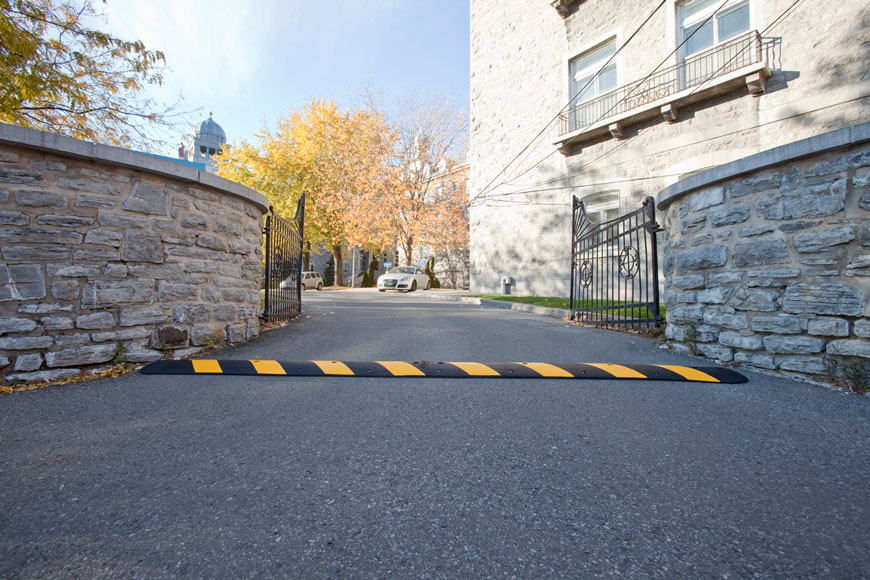
Speed bumps, sometimes called road bumps or bumps, are used in speed zones of 10-15 mph. They are often seen on local streets or link roads where traffic needs to flow smoothly but speeding endangers pedestrians. Playgrounds and school areas often use these in traffic management.
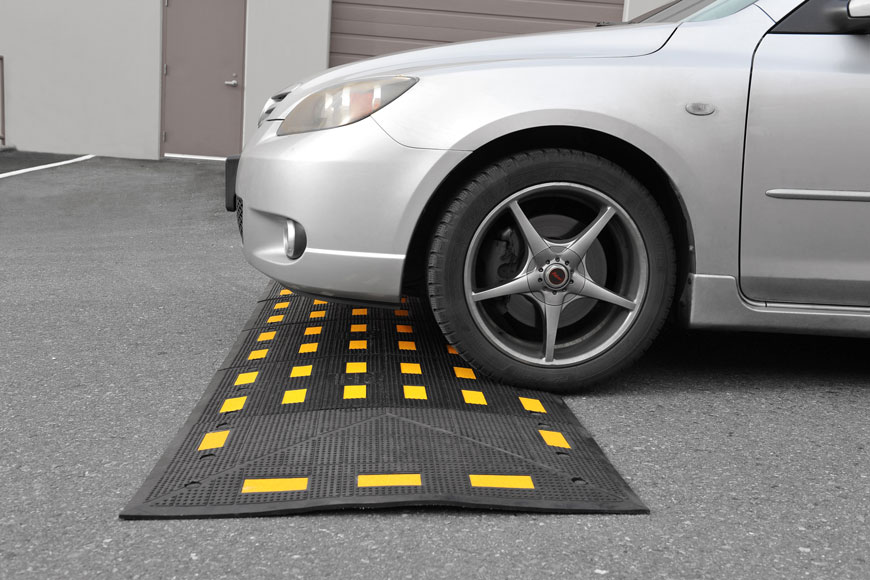
Speed humps create a slight shaking sensation when a car passes the prescribed speed limit. If a car is driven at an unsafe speed, the hump can jar the vehicle and its contents, causing discomfort to the occupants and damage to the cargo. These obstacles usually span the lane in which they are located. This way, vehicles are encouraged to pass them on two wheels, reducing the likelihood of bottoming out.
Speed reduction belts come in a variety of shapes and stroke lengths. These factors influence the discomfort experienced by a speeding vehicle. Stroke length varies from 3 to 20 feet. Any travel length longer than the vehicle produces only one up-and-down motion, while any travel length shorter than the vehicle produces two rocking motions for each set of wheels passing by. Speed bumps are often placed in series to maintain speed along long corridors.
These vertical deflections are not a good option for arterial roads, emergency routes, or any street where cars can easily drive over the shoulder to avoid a hump. As such, they are typically installed on one to two lanes in local urban environments where there are curbs and enclosed sewers. If speed bumps are installed in areas with shoulders, they are often paired with bollards or other obstructions to prevent cars from leaving the road.
Speed bumps
Speed humps are a more active traffic calming option than speed humps, so they are useful where pedestrians and cars closely share space, such as parking lots and driveways. Speed humps typically slow traffic to 2-10 mph, giving people and cars time to react to each other safely. Speed humps are rarely used on public roads because they require vehicles to stop nearby to pass and can cause damage to cars traveling at normal speeds.
Speed bumps can be two to four inches high, but they travel a much shorter distance than speed humps. These barriers sit under the vehicle's tires, last less than half a wheel rotation, and have standard widths between six inches and two feet. The ratio of height to travel distance can cause the vehicle to bounce suddenly, shaking the occupants and cargo. Since speed bumps are always much smaller than the vehicle passing over them, each axle will cross separately, meaning a speeding car will receive two noticeable bumps.
Speed humps, like their quieter siblings, can be placed at intervals to maintain slowing down. They are usually spaced wisely as they are more uncomfortable at any speed and are used in smaller geographical areas.
Speed bumps can pack a punch, which is perhaps why they're given colorful names around the world. They have been called "speed breakers" (India), "jitter sticks" (New Zealand), "sleeping policemen" (UK) and "road turtles" (southern United States). In French, they are called "dos-d'âne," which literally means "humpback whale."
Benefits and Considerations
One of the great things about speed bumps and humps is that no matter how much a driver gets used to their presence, they still act as a deterrent. Flashing signs or intermittent traffic enforcement can temporarily change behavior, but drivers often revert to their previous behavior. One can ignore the signs, but not the road below. For drivers who drive too fast, the same discomfort occurs whether they are passing a speed bump for the first time or the hundredth time.
Road bumps are not suitable for all traffic calming scenarios. Obstacles work best when the driver knows the obstacle is coming and starts slowing down before reaching the edge. Speed humps and humps are often well marked with contrasting colors or reflective surfaces to ensure visibility, but they also need to be installed where drivers can see them. They are not effective when used in the middle of long curves or on streets with gradients greater than 8%. Steeper grades can also change the effective height of a speed hump or bump and have a larger than expected impact. Visibility can also be an issue in some winter climates where snowfall is deep and local streets are not plowed.
Speed bumps and bumps are also not recommended on main or emergency roads as they can cause danger. If unexpected or traveling too fast, these obstacles can cause the driver to lose control or damage the vehicle.
However, when used in the right setup, these are the most adaptable tools in the traffic management toolbox.
Materials and installation
Speed humps and speed humps are usually made of rubber or asphalt. Plastic, metal and concrete options are also available.
When these barriers are made of rubber or plastic, they easily fit over existing surfaces, allowing for quick and efficient installation. Both options are lightweight and can be installed temporarily. Very tight installations, many mounted closely together, can create challenges for snow removal in winter climates: rubber and plastic speed humps can be removed to facilitate these operations.
Rubber is more compressible than asphalt or concrete, which is advantageous for vehicles that are hit too quickly, at an angle, or low to the ground, as it is less likely to cause damage to the vehicle. This greater compression means that rubber barriers of the same height are slightly less effective at slowing traffic than similar asphalt devices, and rubber or plastic are not ideal for roads where heavy industrial traffic continues. Under normal circumstances, however, rubber is tough, durable, and inexpensive to purchase and install.
Asphalt or concrete speed humps are typically installed by municipal road crews or private paving companies. They must have precision and expertise in the field, otherwise the installation may go badly. With a sufficiently specialized crew, asphalt can allow for customized obstacle shapes and travel lengths. These two materials are less compressible and therefore slightly more effective at slowing down than rubber or plastic. However, over time and in changing weather, asphalt and concrete tend to wear and crack.
Simple and effective traffic management
Both speed bumps and humps help encourage safe driving in pedestrian zones. Speed bumps are useful where traffic needs to flow, and speed bumps are useful in small areas where pedestrians and traffic share space more equally. Both methods are less planning intensive than other physical traffic calming methods such as roundabouts or one-way streets, and the modular, pre-built versions can be installed simply and cheaply on existing surfaces. If placed on the right stage, larger speed humps and their smaller but mighty cousins, speed bumps, become traffic safety superstars.