



Traffic cones are ubiquitous safety markers on roads, parking lots, and construction sites – an estimated 140 million cones are in use worldwide. Given how common they are, drivers often wonder whether brushing against or running over one could harm their vehicle's paint or body. In practice, modern traffic cones are made of soft, flexible plastics or rubber so that a collision with a car usually does very little damage. For example, one equipment supplier notes that if a vehicle runs into a cone, the result is "seldom more than a superficial scuff." In fact, the U.S. Federal Highway Administration's Manual on Uniform Traffic Control Devices (MUTCD) explicitly requires cones to be made of "material that can be struck without causing damage to the impacting vehicle." In short, cones are designed to yield, bend, or fall over, protecting cars from serious harm.
Cone Materials and Design: Minimizing Impact
Traffic cones today are generally made from soft plastics (PVC) or rubber with a heavy base, precisely so they will flex or tip when struck. Most standard cones are molded from polyvinyl chloride (PVC), sometimes blended with softer additives. This PVC is pliable and weather-resistant: when a car bumper or tire strikes a cone, it tends to bend rather than chip or scratch. As one traffic-safety guide explains, a PVC Traffic cone's "flexibility allows the cone to bend when hit by a vehicle, reducing damage to both the cone and the car."
Modern cones often have UV-treated or enhanced plastic (or even LDPE plastic) that is extra tough yet springy. For instance, one maker notes that their LDPE cones "can take a hammering and return to their original shape" after impact. This flexibility is critical: it means a glancing blow tends to leave only a rubber or plastic smudge, not a dent or gouge in the metal.
Most cones also feature a heavy rubber base that anchors them. A wide, weighted base (often 3–12 pounds) keeps the cone upright and ensures it will tip over easily rather than break on impact. In fact, some high-end cones put 80% of their weight in the base alone. This design (soft plastic top + heavy rubber bottom) means that if a car bumps into a cone, the base simply slips or tilts, and the cone may skid or fall away.
In short, traffic cones are built to be low-impact. They typically have no jagged parts or exposed metal; all surfaces are smooth plastic or rubber. Regulatory standards reinforce this: the MUTCD specifies that cones must be predominantly orange and stable enough to withstand traffic flow. Cone manufacturers design accordingly – for example, economy cones are described as "all vinyl construction for greater durability and flexibility" and "made to withstand impact." Heavy-duty cones (for highways) are often thicker rubber or weighted PVC, making them even more resistant to wind, vehicles, and wear.
Vehicle Contacts: Cone Strikes and Potential Damage
When a vehicle actually contacts a traffic cone, the outcome depends on speed and angle, but in most low-speed cases it's benign. If you gently tap a cone – say brushing it with a bumper or wheel in a parking lot – the cone will usually just tilt or roll. The soft plastic may leave a faint mark or residue on the paint, but this typically wipes off with a car-safe cleaner or wax. One supplier observes that if a car does hit a cone, the harm is "seldom more than a superficial scuff."
Of course, more forceful collisions change the story. Striking a cone at highway speeds or with a heavy vehicle can break the cone itself. In a high-speed hit, the plastic cone may shatter or crumble under the car's wheels, potentially even being propelled as debris. Even then, most of the damage tends to be to the cone – the vehicle might receive only paint transfer or a shallow scratch from a hard fragment.
To summarize the typical scenarios:
- Low-speed bump: usually only leaves a scuff.
- Rolling over a cone: cone crumples; car rarely scratched.
- High-speed strike: cone destroyed; car rarely dented.
In no case is the cone meant to act like a solid object.
Choosing Cones for Parking Lots & Garages
When setting up cones in tight spaces, it's important to pick cones sized and built for those conditions:
- 12″ cones: good for indoor, very low-traffic use.
- 18″ cones: MUTCD minimum for low-speed zones; ideal for parking lots.
- 28″–36″ cones: highways and high-traffic areas.
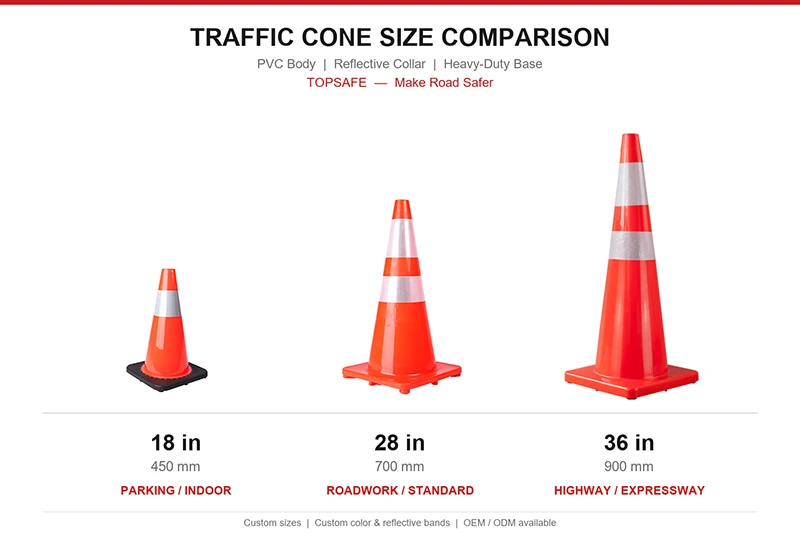
Other features to consider: material (PVC or rubber), base type (wide rubber base), visibility (bright orange, reflective collars), and regulatory compliance (MUTCD-approved). Accessories like cone weights or reflective collars increase stability and safety.
Dealing with Cone–Vehicle Collisions
If a traffic cone does strike your vehicle:
Inspect your car for scuffs or cracks.
Clean marks immediately with car-safe cleaner or wax.
Report the incident if in a managed site.
Document any damage for insurance if necessary.
Most marks are superficial and can be polished away.
Preventive Measures
Drivers: slow down, give cones space, wash off residue.
Site Operators: use stable cones, correct placement, ensure reflectivity, replace damaged cones, and educate workers.
Safety Standards and Regulations
The MUTCD requires cones to be:
Predominantly orange and at least 18″ tall in low-speed areas.
Taller (28″+) with reflective collars in higher-speed or nighttime use.
Made of flexible material so they do not cause vehicle damage.
In other words, U.S. federal standards anticipate cone-vehicle collisions and require cones to be non-damaging by design.
Traffic cones are not a major threat to cars. They're designed to flex, bend, or fall rather than cause harm. Most contact results in at most a light scuff that can be polished away. Still, careful driving and proper cone selection and placement further minimize risks. Cones protect drivers and cars alike – provided they are chosen and used correctly.
🦺 Stocking cones for a parking facility or construction site?
We manufacture MUTCD-compliant PVC traffic cones in 12" to 36" sizes, with heavy rubber bases and high-visibility reflective collars. All cones are built from flexible PVC that bends on impact - protecting both vehicles and your liability.
Bulk pricing available for government and commercial buyers.
👉 Browse Our Full Traffic Cone Catalog
👉 Request a Quote for Your Project. Contact now