


Most barricade light specifications quote one number: 3,000 feet on a clear night. The figure is real, it comes from the national standard, and it is misread almost every time it appears in a purchase order. Crews treat it as the distance at which a barricade must be placed. It is not. The MUTCD uses the number to describe what a light must be capable of doing in serviceable condition, not where a device belongs on the road.
Quick answer: how far a barricade light must be visible
Section 6L.07 sets the requirement by type. Type A low-intensity flashing, Type C steady-burn and Type D 360-degree steady-burn lights must be maintained so they are capable of being visible on a clear night from 3,000 feet. Type B high-intensity flashing lights carry a different test: 1,000 feet on a sunny day, viewed without the sun directly on or behind the device. Both are performance conditions on the hardware. Placement is governed by stopping sight distance, about 495 feet at 55 mph and 645 feet at 65 mph.
What the standard actually says
The controlling sentence is Standard paragraph 13 of Section 6L.07, Flashing Beacons and Warning Lights, in Chapter 6L of the 11th Edition with Revision 1. It splits by light type rather than road class, which is the detail most field arguments miss.
| Type | Mode and intensity | Required visibility | Typical use |
|---|---|---|---|
| A | Flashing, 55 to 75 per minute, 4 cd effective | 3,000 ft, clear night | Isolated hazard at night, on barricades, drums or signs |
| B | Flashing, 35 cd effective | 1,000 ft, sunny day | Advance warning signs, continuous operation |
| C | Steady burn, same class as Type A | 3,000 ft, clear night | A series delineating the edge of the traveled way |
| D | Steady burn, 360 degrees, same class as Type A | 3,000 ft, clear night | Two-way traffic, both directions must see it |
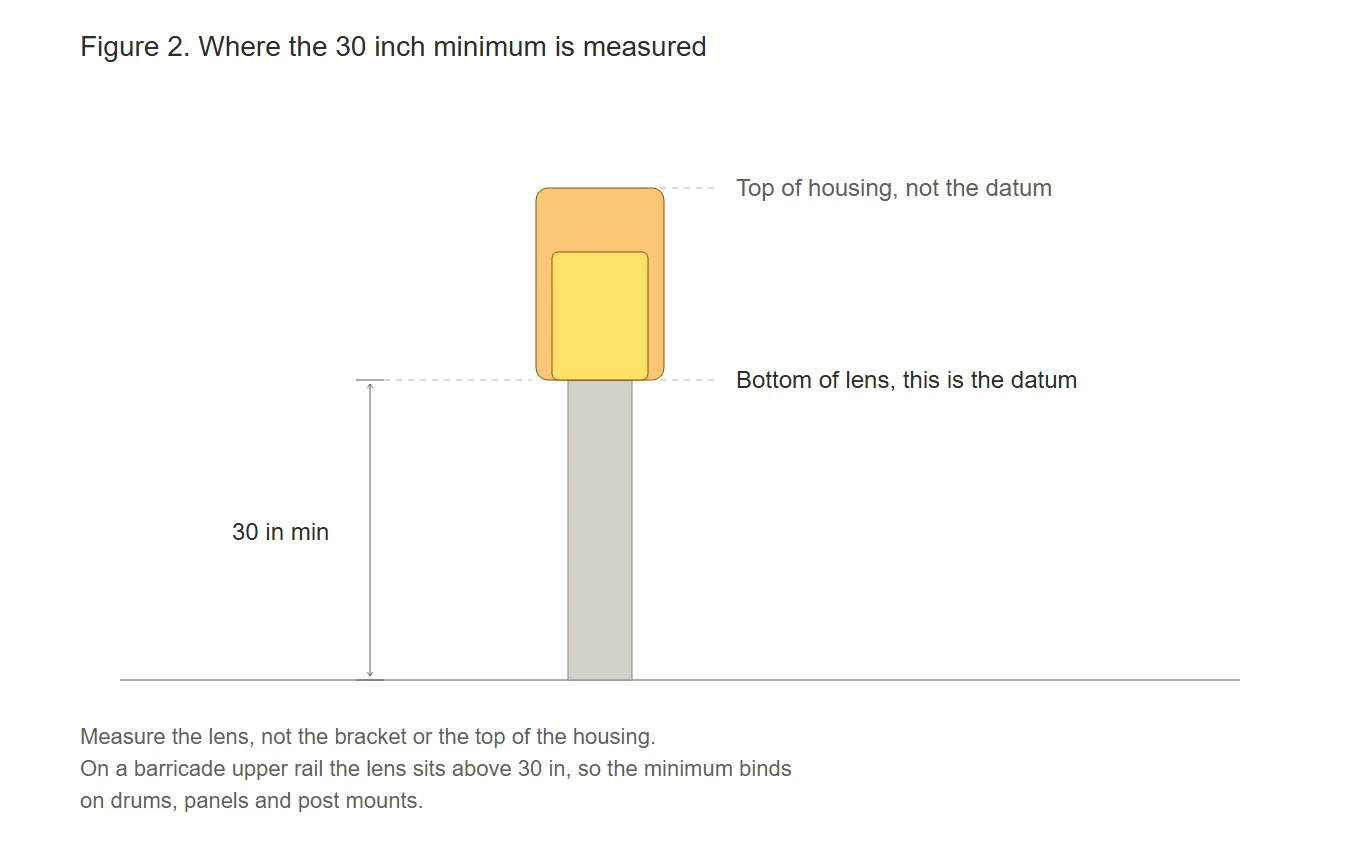
Three conditions travel with that table. Warning lights need a minimum mounting height of 30 inches to the bottom of the lens, not to the bracket or housing. Type B is the only type with a daylight test, which is why those units run continuously rather than dusk to dawn. And the hardware must comply with Chapter 13 of the ITE Equipment and Materials Standards, the source of the intensity and flash duration figures.
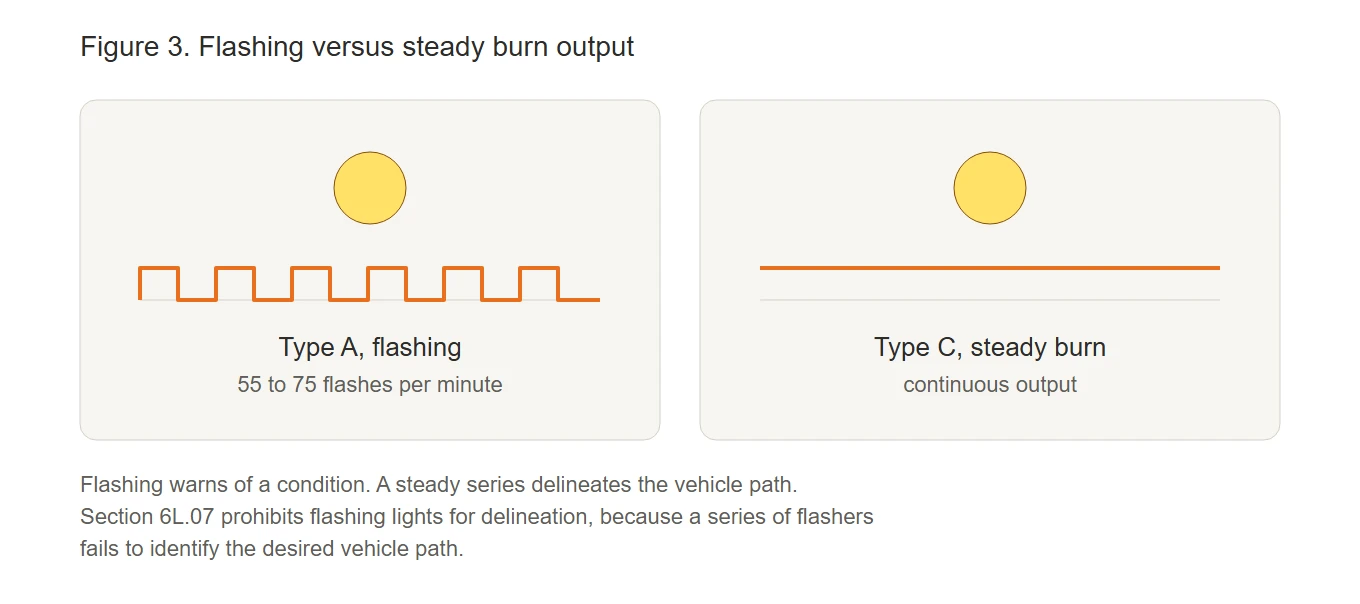
Paragraph 9 requires a light to flash when it stands alone or in a cluster warning of a condition. Paragraph 10 requires steady-burn when lights run in a series to channelize. Paragraph 11 closes the loophole: flashing lights shall not be used for delineation, because a series of flashers fails to identify the desired vehicle path. The exception is a sequential flashing series on a merging taper, at 55 to 75 per minute.
Why 3,000 feet is not a design distance
Three thousand feet is just over half a mile. At 55 mph that is about 37 seconds of travel, and no traffic control plan is built around a barricade being identified half a mile away.
What the figure buys is detection margin: the distance at which a driver can pick the light out of the background before deciding what it means. Detection scales with distance, and it is the part the standard protects.
Layout is governed by stopping sight distance, the distance in which a driver must stop or change path: about 495 feet at 55 mph and 645 feet at 65 mph on level grade with good friction, more on downgrades. The specification asks for roughly six times the 55 mph value. Advance warning spacing, from the tables in Chapter 6C, usually fixes the most upstream device on the approach.
What shortens the visible distance in the field
The figure assumes a clear night and a serviceable light. Field conditions move it downward for mundane reasons. A dirty or frosted lens is the common one: road film and dried spray cut transmitted light long before the battery does, invisibly in daylight. A weak battery shows up as reduced intensity and, on some units, a slower flash. Rate is part of the specification, 55 to 75 per minute, so a unit pulsing at 40 looks like it works.
Mounting below 30 inches is the third. Low mounting puts the light into the glare of oncoming headlights, behind the crest of any rise, and below the sight line of a high-cab driver. The minimum is measured to the lens, so a bracket that lifts the housing while leaving the lens low does not satisfy it.
For Type B the caveat is built in. The 1,000 foot daylight figure applies when the sun is not directly on or behind the device, so facing a Type B light into a low morning sun loses it, and intensity cannot fix the geometry.
Barricade geometry that affects what a driver sees
A barricade light is mounted on a device, and the device decides where the light sits and what surrounds it.
Type I carries one rail at least 24 inches long and 8 to 12 inches tall, upper edge at least 36 inches above ground. Type II carries two such rails with the same 36 inch minimum. Type III carries three rails at least 4 feet long, upper edge at least 5 feet above ground, and it is the type used to close a road.
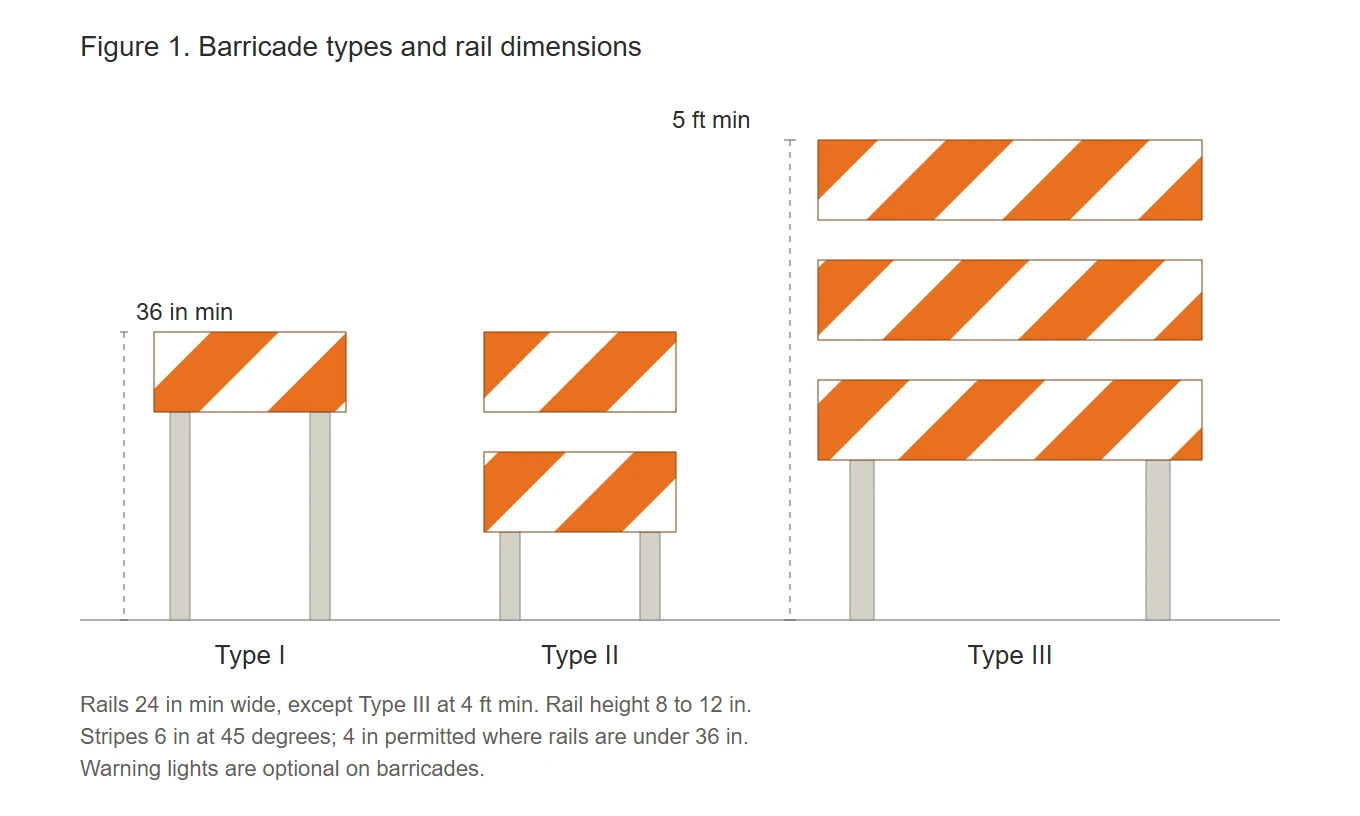
Rail faces are retroreflective, with alternating orange and white diagonal stripes at 45 degrees, 6 inches wide, with 4 inch stripes allowed where rails are shorter than 36 inches. Barricades on freeways need at least 270 square inches of retroreflective area facing road users.
The combination is what a driver reads. The light provides detection; the rail face provides shape and the closure message. A working light on a weathered rail reads as a smudge of flashing, and good rails with a dead light read as an unlit obstruction.
Warning lights are an option under the national standard. Paragraph 2 of Section 6L.07 states that warning lights may be used to supplement retroreflectorized signs, barriers and channelizing devices, so adding them is a decision about hazard, exposure and duration. State supplements and project specifications often make them mandatory for night closures.
Choosing the type, then the photometry
Choose by role. Type A for a spot hazard at night. Type B where the warning must work in daylight or the hazard justifies continuous operation. Type C to delineate a series along one direction of travel. Type D where traffic passes on both sides. Type C and Type D belong on the outside of a curve, never the inside.
Then read the photometry properly, because this is where specifications go vague. Effective intensity is not instantaneous intensity: a flash is integrated over its duration, so a short pulse must be brighter to read the same. A Type A unit at 4 cd effective is about 6 cd fully on at a 50 percent duty cycle, or 12 cd at 10 percent. A Type B unit at 35 cd effective is roughly 49 cd at 50 percent and 105 cd at 10 percent.
That is why two lamps quoting different candela figures can be equivalent when their flash durations differ, and why a lamp advertised on peak intensity alone says little about compliance.
Two points belong in a purchase order. The yellow chromaticity range, since a lens can hit the intensity figure and still sit outside the color box. And intensity has to hold across a defined solid angle rather than on axis alone: a lens that falls away at 50 degrees off axis does not read the same to a driver in the next lane.
Checking visibility in the field
A night check takes fifteen minutes and no photometer. Clean the lens, stand at a marked distance on the approach, and confirm the light reads as a warning device rather than a point of light. Measure the mounting height to the bottom of the lens, count the flash rate over a full minute, and check that every unit in a series is in the same mode. Then look from the driver's position rather than the shoulder: if the rail face has weathered out, the light is doing work the sheeting was supposed to share.
Sourcing barricade lights for a work zone programme
Topsafe supplies barricade warning lights in flashing models, with units that switch between flashing, steady and off, in solar and 4R25 6V battery versions. Housings are polycarbonate lens on a polypropylene base, and the base turns a full circle so the lens can be aimed along the approach, on barricades, drums, cones and panels.
Send the application, road class and posted speed, whether the lights must operate in daylight, the units per zone and the mounting device. We will return a configuration proposal, the available data sheets and a sample arrangement for a night trial.
FAQ
Is 3,000 feet a legal placement requirement?
No. The clause requires warning lights to be maintained so they are capable of being visible at 3,000 feet on a clear night, a performance condition on the device rather than a placement distance. Layout comes from stopping sight distance, advance warning spacing and the traffic control plan.
Why does a Type B light have a shorter visibility figure than Type A?
The figures measure different conditions. The 3,000 foot figure applies to Type A, C and D lights on a clear night. Type B carries 1,000 feet in daylight, without the sun on or behind the device, which is the harder test. Hence 35 cd effective against 4 cd.
Can flashing lights outline a lane closure?
Not as delineation. Paragraph 11 states that flashing lights shall not be used for delineation, because a series of flashers fails to identify the desired vehicle path. Use Type C or Type D steady-burn for a delineating series and reserve flashing for warning.
What is the minimum mounting height for a barricade light?
30 inches to the bottom of the lens. Measure the lens rather than the bracket or housing, because a mount that raises the body while leaving the lens low does not meet the requirement.
Product configuration and material details reflect the current Topsafe barricade light range. Confirm the applicable data sheet for your project before ordering.